Your Foundation Is Thirsty Too: What Westoplex Clay Soil Is Doing to Your Home Right Now

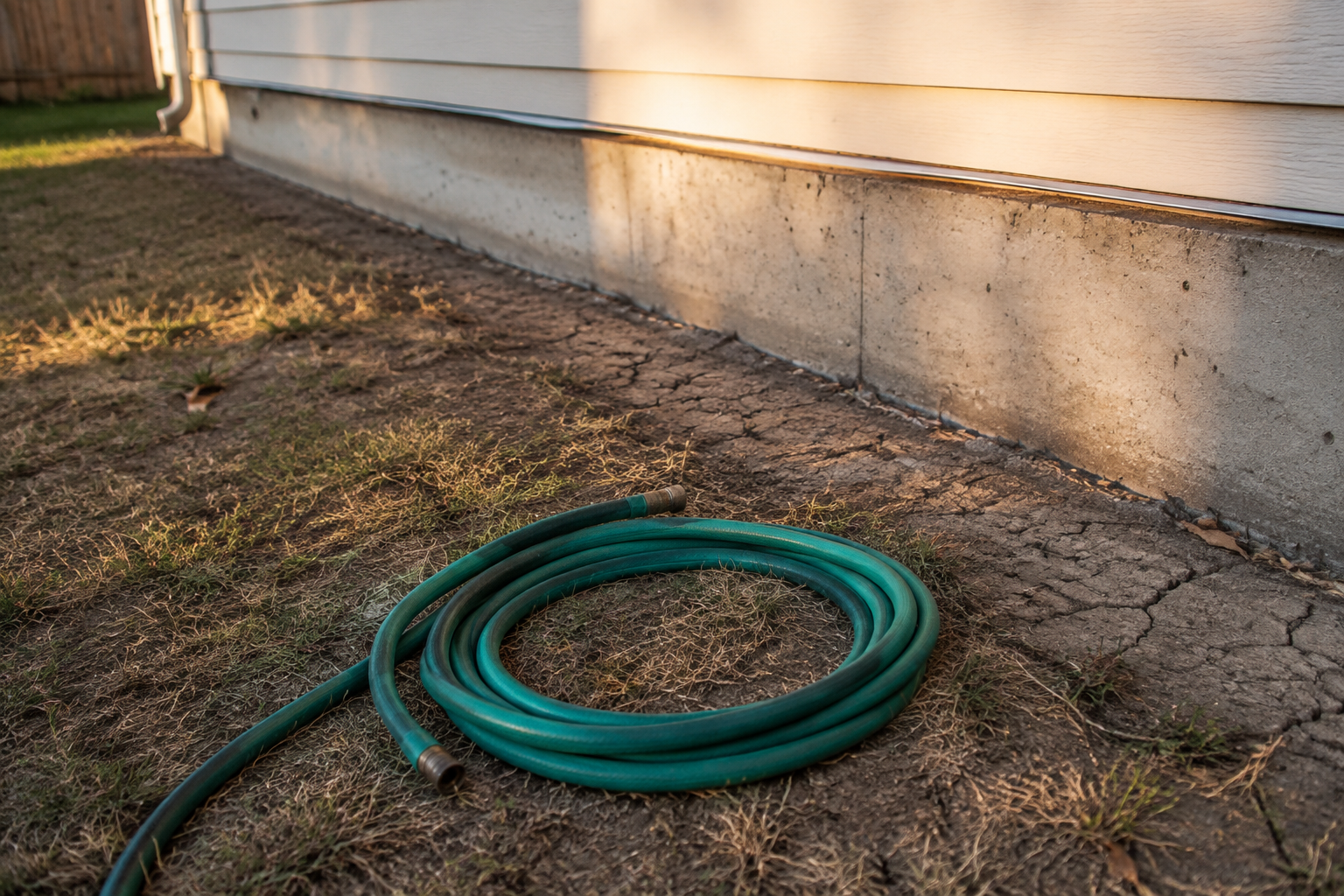
Sticky doors and hairline cracks in your drywall aren't a sign your house is haunted. They're a sign your soil is dry. Most of the ground under Westoplex homes is expansive clay, and right now, in the hottest stretch of the year, that clay is shrinking away from your foundation.
Why Texas dirt does this
The clay under North Texas is what geologists call expansive, or Vertisol. It swells when it's wet and shrinks when it's dry, sometimes by a large margin. Level Up Construction, a Cleburne-based foundation repair company that works across our region, puts the swelling at up to 30 percent by volume in a single moisture cycle. That's not a typo. Nearly a third more soil volume when it's saturated versus bone dry.
That swing puts uneven pressure on a slab. One side of your house can lift while the other drops. Expansive soils contain minerals capable of absorbing water, and expansions of ten percent or more aren't uncommon, which can exert enough force on a building to cause real damage. Multiple industry and academic estimates put the national damage bill from expansive soils somewhere between $2 billion and $15 billion a year, with figures varying a lot depending on who's counting and what they count. I'm not going to pretend there's one clean number. What's consistent across every source I checked is the underlying mechanism: this is a moisture problem, not a mystery.
Worth knowing: most of the detailed public guidance on this topic online comes from foundation repair companies. That doesn't make the information wrong, but it does mean you're reading advice from businesses that also sell repairs. Treat the specific numbers below as industry consensus, not laboratory data.
How to actually water your foundation
Here's the routine, pulled largely from Level Up Construction's guide and cross-checked against Atlas Foundation Repair, a Fort Worth company that's been doing this since 1958.
- Place a soaker hose or drip line 12 to 18 inches out from the slab. Not touching it. Water that pools directly against the foundation can travel through soil cracks and undermine the grade beam instead of stabilizing it.
- Run it 30 to 45 minutes, three times a week, during hot, dry stretches. Early morning loses less water to evaporation.
- Check the soil, not the calendar. Stick a screwdriver into the ground near the foundation. If it won't go more than an inch or two without a fight, the soil's telling you it's too dry.
One flag here: Atlas Foundation's own guidance is slightly different. They recommend placing the hose about a foot out and running it daily through summer, aiming for moisture a few inches deep, rather than three sessions a week. Both companies work in this exact market and both know what they're talking about. I'm giving you the range rather than pretending there's a single magic number, because there isn't one. Start with the 12-to-18-inch, three-times-a-week approach and adjust based on what the screwdriver tells you.
[my take]
Yes, you're allowed to do this even under water restrictions
This is the part people don't know, and it matters. Fort Worth's own irrigation guidance states plainly that drip irrigation exists specifically to allow for the protection of structural foundations, trees, and other high-value landscape materials. The city's 2014 water conservation ordinance spells it out directly: lawns and landscaping, including structural foundations, may be watered on any day, at any time, by handheld hose, drip irrigation, a soaker hose or tree bubbler, and that's the explicit intent of the rule. fortworthtexasCity of Fort Worth
Weatherford works the same way. The city's own enforcement page lists watering-day and watering-hour violations as the things that get cited, and hand watering and drip irrigation are consistently treated as exceptions across the drought-stage plans I found for the city. Benbrook's public materials point the same direction, though I couldn't confirm the exact current-year schedule from Benbrook's own site rather than a third-party summary, so call the water department before you assume anything.
Aledo's water conservation page lays out a year-round twice-a-week watering schedule and points residents to a regional AgriLife irrigation workshop, but I didn't find foundation-specific exemption language on the city's own site the way Fort Worth spells it out. If you're in Aledo, I'd call the city's utility billing office directly and ask about foundation watering before you set up a drip system, just to be safe.
Bottom line across the board: soaker hoses and drip lines aimed at a foundation are treated differently than sprinklers almost everywhere in this region, but "almost everywhere" isn't "everywhere." Confirm with your specific provider.
What this means if you're buying or selling
Foundation issues show up on inspections, and they show up in negotiations. A homeowner who's been running a soaker line all summer walks into a listing appointment or a buyer's inspection in a much stronger position than one who hasn't. This isn't about home values going up. It's about avoiding a $4,000 to $12,000 repair bill and the negotiating headache that comes with it at closing, a range Level Up Construction cites for typical residential jobs in this market.
For Move-Up Buyers shopping resale homes in Westpark or Timbercreek in Benbrook, or Bear Creek, Morning Star, Parks of Aledo, and Walsh Ranch out toward Aledo, ask the seller directly whether they've been watering the foundation through the summer. It's a fair, normal question, and a seller who's been doing it usually has no problem saying so.
For Empty-Nesters looking at lower-maintenance living in Westover Village in Weatherford or Ventana in Fort Worth, this is one more thing to factor into the "how much upkeep do I actually want" conversation. A soaker hose on a timer is about as low-effort as home maintenance gets, but it is still a task, and it's worth knowing that going in.
New construction isn't exempt from any of this. Fresh slabs sit on soil that hasn't fully settled, and the ground around a new foundation needs consistent moisture through at least its first couple of summers just as much as a 40-year-old pier-and-beam home does. New construction and resale both live on the same clay. Neither one gets a pass.
Sources
Aledo, City of. (n.d.). Water conservation. https://www.aledotx.gov/WaterSaving
Atlas Foundation Repair. (n.d.). Protect your foundation from hot, dry summer weather. https://www.atlasfoundationinc.com/protect-your-foundation-from-hot-dry-summer-weather/
City of Fort Worth. (2014). Water conservation ordinance (Ordinance No. 21194-04-2014). https://www.fortworthtexas.gov/files/assets/public/v/2/water/documents/save-water/water-conservation-ordinance-2014.pdf
City of Fort Worth Water Department. (n.d.). Irrigation insights: Smart watering for Fort Worth. https://www.fortworthtexas.gov/departments/water/savefwwater/irrigation
City of Weatherford. (n.d.). Enforcement/reporting violations. https://weatherfordtx.gov/1481/EnforcementReporting-Violations
Geology.com. (n.d.). Expansive soil and expansive clay. https://geology.com/articles/expansive-soil.shtml
Mr. Sprinkler Repair. (n.d.). 2024 Weatherford, TX water restrictions. https://mrsprinklerrepair.com/?p=20172
Mr. Sprinkler Repair. (n.d.). 2024 Benbrook, TX water restrictions. https://mrsprinklerrepair.com/?p=19589
Stevenson, J. (2026, April 29). How to water your foundation: A Texas homeowners guide. Level Up Construction & Services. https://levelupcsllc.com/how-to-water-your-foundation/
Related Reading
I didn't find an existing Westoplex Harville post specifically on foundation care or drought maintenance to link back to. If one exists that I'm not aware of, drop the URL in and I'll wire it in. Otherwise, this could be a good candidate for a first entry in a "homeowner maintenance" series, since the topic will resurface every summer.
[Click here to sell your home!]
[Click here to buy your home!]
[Click here to go back to Westoplex Harville]